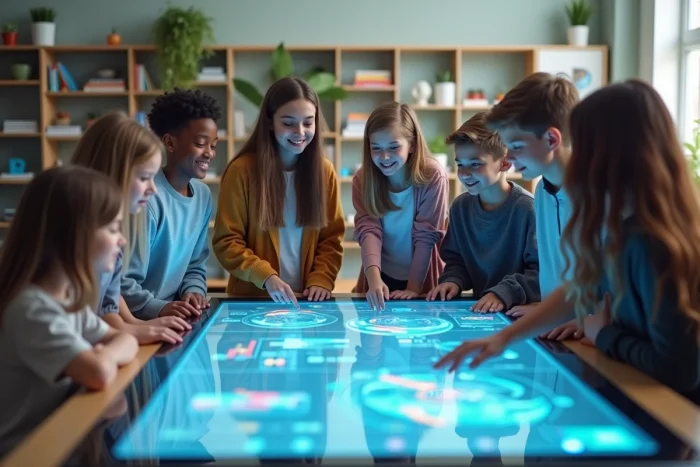
A school textbook placed on a touchscreen no longer shocks anyone: schools are no longer turning their backs on technology; they are integrating it, shaping it, and sometimes confronting it. The deployment of 3D digitization in educational institutions is no longer a marginal experiment. Since 2021, some French high schools have been replacing traditional textbooks with interactive models, changing the usual pedagogical benchmarks.
In classrooms, the emergence of augmented reality does not go unnoticed. Teachers report increased participation during sessions where these tools are used, even though access to equipment remains very unequal across institutions. This is a significant challenge, compounded by regulatory changes that profoundly transform the teacher’s role: it is now about supporting, guiding, but also experimenting with students.
Why the digital revolution is changing the game in education
Schools are no longer just adding technologies to what already exists: they are seizing them to rethink their practices, tools, and ambitions. The digital transformation shakes everything up: from course content to collaboration methods, from primary school to university. Artificial intelligence is no longer limited to automating tasks: it makes customized learning possible, following the student’s pace, detecting their needs, and adjusting pathways.
In classrooms, platforms now centralize resources, facilitate tracking, and streamline communication between teachers and students. Gamification awakens motivation, while mobile learning removes geographical barriers. Well-utilized data becomes a tool to identify difficulties, react quickly, and individualize support.
Blockchain is establishing itself to guarantee the reliability of diplomas, while quantum computing is beginning to open new avenues for research. But all these innovations also raise questions. Inclusion and accessibility are no longer options: everyone must benefit from these advancements. Cybersecurity is becoming a priority, as students’ data is now an asset to protect. Open educational resources are making their way, opening access to knowledge for those who have been deprived of it until now.
To better understand these upheavals, https://www.mitxdesigntech.org/ offers a detailed exploration of the links between design, technology, and pedagogy. It reveals how innovation permeates every dimension of teaching: hybrid models, adaptive learning, intergenerational mentoring… All responses to the growing diversity of pathways and the rapid evolution of skills expected in the job market.
3D digitization and augmented reality: what concrete uses for learning differently?
Among the tools that are changing the game, 3D digitization and augmented reality now take center stage. These technologies do not just enrich the lesson: they disrupt the way of learning. One no longer simply reads a diagram: one manipulates it. A student can explore the details of a molecule, traverse the floors of a historical building, or examine the functioning of a human organ without leaving their classroom.
To illustrate these contributions, here are some concrete applications that are multiplying in institutions:
- In biology, a student observes the human skeleton in augmented reality, moves a joint, simulates an injury, and understands its consequences on posture or movement.
- In physical sciences, manipulating 3D models allows for understanding the structure of molecules or the functioning of electrical circuits, with the possibility to experiment and correct mistakes immediately.
- In history or geography, augmented reality brings back to life lost archaeological sites or allows visualizing the evolution of a territory over time.
These are not just gadgets. Teachers use them as levers to make students active participants in their learning. Manipulation, experimentation, trial and error become central steps in acquiring skills. Project-based pedagogy is strengthened: at university, students and teachers design and test prototypes together in innovation platforms conceived as idea laboratories.
Design thinking is being integrated into curricula, encouraging teamwork, iteration, and seeking new solutions to real problems, in connection with researchers or professionals. Fablabs and third places, on the other hand, offer a space for collective experimentation: here, technology is not an end in itself, but a means to build, critique, and imagine differently.
We are thus witnessing a gradual shift in the pedagogical center of gravity: knowledge is constructed through action, discovery, and dialogue. Co-construction is becoming the norm, supported by digital tools that make trial, error, correction… and shared success possible.
Immersive experiences in school: what these technologies promise for students and teachers
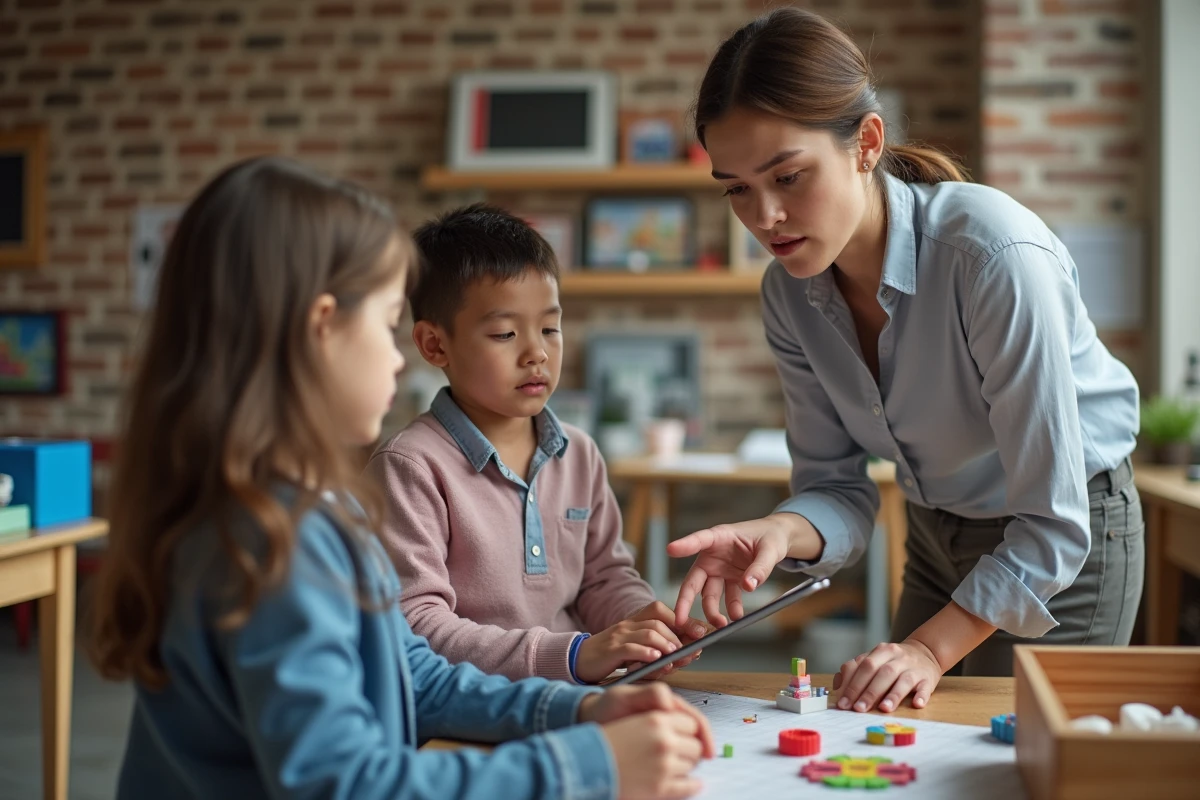
The massive arrival of virtual reality and augmented reality reshuffles the cards in classrooms. No longer is it a question of remaining passive: the student manipulates, explores, simulates, and understands through direct experimentation what no textbook could convey. Exploring a cell, reliving a historical event, or testing a scientific experiment: everything becomes accessible, lively, and concrete.
For teachers, these tools open the door to true personalization of learning. Artificial intelligence analyzes responses, detects blockages, and suggests appropriate resources. The student is no longer a spectator: they progress at their own pace, supported, stimulated, encouraged to take their place in the learning process.
But the issue of access does not disappear. Making these innovations accessible to all, including students far from school or with disabilities, remains a priority. Voice interfaces, adapted content, mobile applications: each technical solution must aim for equal opportunities in the connected classroom.
Beyond pure knowledge, these devices foster the development of human skills: creativity, critical thinking, adaptability. For institutions, the challenge is set: to support the transformation, invest in training, and make innovation a lever for empowerment for every student.
The classroom is transforming, but the bet remains the same: to awaken curiosity, broaden horizons, and give each generation the means to shape its own future. Who would have thought that the next revolution in education would fit in the palm of a hand, behind the screen of a tablet, or in the cradle of a virtual reality headset?