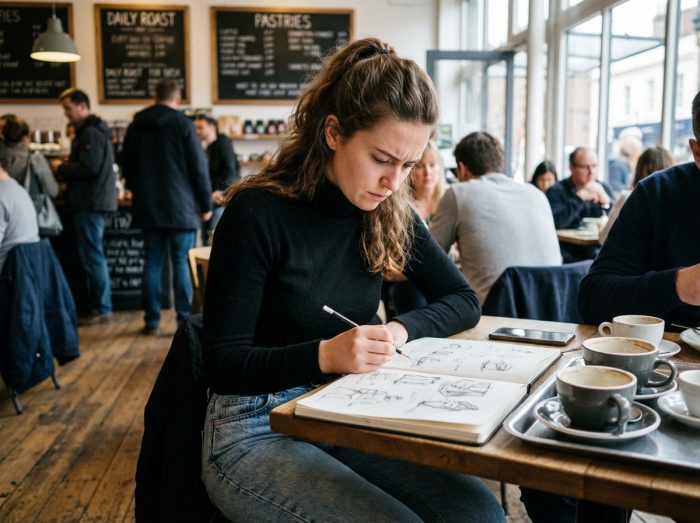
Mandatory part-time work, optional precarious employment, and in the end, half of the degrees flying away: the journey of a student in artistic training often resembles a tightrope act without a net. The systems meant to cushion the fall do exist, but remain out of reach for many students, either due to a lack of information or because of the internal policies of certain institutions.
Between passion and necessity: why so many art students juggle a survival job
In schools of visual arts or design, precariousness affects the majority. According to the Student Life Observatory, nearly one in two art students must take a student job alongside their artistic curriculum. This is not a whim, but a matter of survival: paying for housing, renewing materials and supplies, getting a metro ticket. The part-time contract dominates, yet the “job compatible with studies” touted in advertisements quickly clashes with the poorly synchronized demands of professional and school life. One ends up confusing economic need with vocation.
If the regulations allow for work-study combinations provided one declares their activity and does not exceed certain hours, the reality imposes tight schedules. Large retail chains or ready-to-wear brands offer student contracts, supposedly flexible. In practice, hours add up, creative energy dwindles, and the margin for artistic projects shrinks to nothing.
A student job of ten to twenty hours per week should, on paper, leave room for artistic training. But a third of working students abandon their creative ambitions by the first year, unable to organize a sustainable schedule without support. Some prefer to declare themselves as self-employed artists: a way to frame their work, access suitable social coverage, and step out of the gray area of undeclared work.
For those looking to effectively balance work and artistic studies without burning out right away, the key is to focus on suitable jobs (library monitoring, occasional missions, workshops) and rethink the logic of the CV: every professional experience, as long as it respects the course schedule, becomes a springboard rather than a burden.
How to avoid burnout when everything seems urgent and important?
Juggling employment and artistic studies exposes one to a crossfire of unforeseen events and demands. Days lengthen, sacrifices accumulate, and burnout ultimately becomes the daily reality for many. Anticipation remains the best defense: equipping oneself with a reliable agenda, whether paper or digital, visualizing deadlines, and incorporating real downtime into the routine.
Before accepting any mission, it is better to honestly assess one’s workload: maintain a rhythm of ten to twenty hours, aim for a part-time job close to home or campus. Often, the ideal lies in small local jobs: library, tutoring, temporary workshops, less commuting, less fatigue, more time freed up for creation.
Discussing with teachers and employers is not a mere formality. Informing them in advance about obligations, requesting an adapted schedule, refusing extended hours: all of this helps keep the goal of obtaining the degree in sight. Claiming one’s limits helps preserve mental health. Holding firm is not just a matter of willpower: endurance relies on concrete foundations like restorative nights, regular breaks, a balanced diet, or even meditation if that works for one. Coordinating with other working students, sharing tips that help maintain stamina, lightens the burden.
For those who want to establish good practices, here are some easily applicable tips:
- Schedule fixed rest periods in your timetable and respect them with the same rigor as a class or contract.
- Keep in mind that success in art has nothing to gain from relying on exhaustion.
Concrete strategies to preserve creativity without sacrificing health
Taking care of one’s mental health is not a privilege but a necessity when balancing work and studies. The first step: set realistic goals, break down large tasks into manageable missions, and refuse the spiral of the race for recognition that sometimes prevails in art schools.
Creating a personal workspace, even a tiny one, can make all the difference. An improvised studio, a dedicated table at the back of a living room, a quiet corner in a shared apartment: the goal is to find a bubble of one’s own to reconnect with inspiration. Joining a collaborative workshop or becoming part of an artist collective helps break isolation, exchange advice and ideas, and avoid suffocating under pressure.
Adapting one’s schedule to the hours when one knows they are more productive is a golden rule. Some discover they are creative early in the morning, while others awaken after a night shift: learning to listen to one’s rhythm helps prevent fatigue. Support from family, friends, and colleagues also matters: they all play their part in moments of doubt. Engaging in local initiatives like exhibitions, markets, or workshops nourishes the network and brings one back down to earth, far from digital isolation.
Continuing education or distance learning also opens up perspectives without weighing down the agenda. Online platforms offer short modules designed to fit into busy schedules. Some public or associative structures support these efforts, taking into account the specific constraints of the artistic sector.
Finding a sustainable posture remains the challenge. But on the tightrope stretched between the need to earn a living and the desire to create, everyone can shape their own balance. Never losing sight of one’s vocation means refusing to sacrifice one’s passion under the weight of small jobs.