A bucolic garden is not declared by the accumulation of rose bushes and wrought iron furniture. It relies on a work of plant structure, management of layers, and soil selection that together create the impression of generous nature without apparent effort.
Plant layers and planting density for a bucolic garden
The key to a convincing bucolic flowerbed lies in the superposition of at least three layers: ground cover, medium perennials, and shrubs with a soft habit. Popular articles list species without ever addressing planting density, whereas it is this that creates the lush effect characteristic of the country style.
We recommend planting perennials in a staggered pattern with reduced spacing compared to the classic recommendations on labels. For perennial geraniums or lady’s mantle, reducing the spacing from 40 cm to 30 cm allows for continuous coverage by the second season. The goal: to no longer see bare soil between the clumps after one year.
Grasses play a binding role between blooms. Stipa tenuissima, Deschampsia cespitosa, or Molinia caerulea bring movement and filter the low light. They should be placed at the edge of the flowerbed or in transition to a meadow area, never in the center of a symmetrical flowerbed.
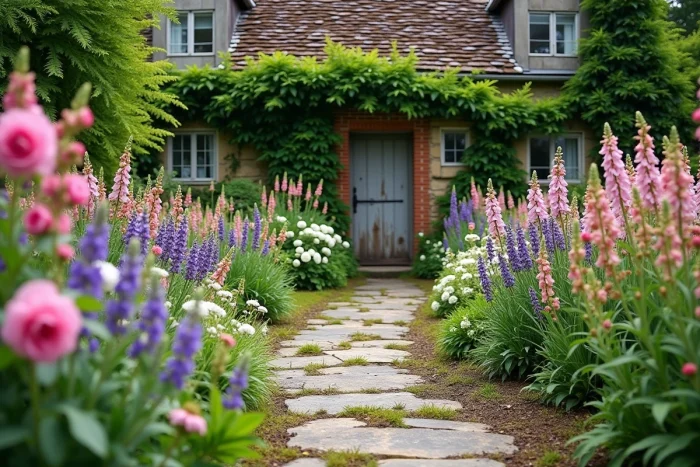
To capture this reimagined English countryside atmosphere, the garden of La Petite Maison dans la Prairie illustrates well how dense and varied plantings create a coherent decor without forcing the decorative aspect.

Soil, mulching, and paths: the surfaces that create the country spirit
A bucolic garden is read as much on the ground as in the flowerbeds. The choice of materials for circulation and ground cover conditions the overall perception of the space.
Irregular paths made of natural stone or stepping stones laid in the grass enhance the impression of an unstructured walk. Interlocking pavers or calibrated concrete slabs immediately break the charm. Favor local stone, crushed limestone gravel, or spaced rough wood planks.
- Natural stone laid on a sand bed, with grass joints to allow clover or sagina to colonize the gaps
- Irregularly sized gravel, held in place by discreet corten steel borders rather than plastic edging
- Unplaned wood (chestnut, black locust) in wide planks, which naturally grays and blends into the plant palette
- Mulch of leaves or chipped branches in generous thickness in the flowerbeds, which nourishes the soil and eliminates weeding
Organic mulching has a dual role in a bucolic garden. It maintains soil life (earthworms, mycorrhizal fungi) and gives that natural brown hue that contrasts with the green of the foliage. We systematically avoid white or light gray mineral mulches, which reflect too much light and create a mineral effect incompatible with the rural spirit.
Micro-habitats and biodiversity in an ornamental garden
A bucolic garden worthy of the name is not limited to aesthetics. For several years, the LPO has encouraged the creation of micro-habitats in private gardens, including very flowery and romantic gardens. The idea: to combine ornamental plants and deliberately wild areas to make the garden a link in ecological corridors.
In practical terms, this means keeping a pile of branches in a discreet corner, installing a shallow water point (a simple buried terracotta dish), and maintaining an uncut strip at the back of the plot. These elements do not detract from the composition; they enhance it. A flowering meadow area at the back of the garden creates visual depth while welcoming pollinators and beneficial insects.
Since the extension of the Labbé law, individuals can no longer use synthetic pesticides. Several local authorities have launched local charters like “Gardening Naturally” that formalize these practices. For a bucolic garden, this regulatory constraint is actually an asset: it encourages acceptance of a degree of plant spontaneity that perfectly fits the style.
Furniture and decorative elements: what works and what betrays the artifice
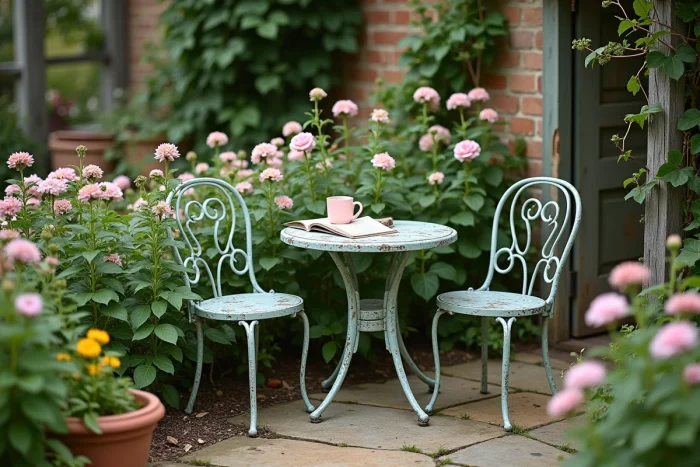
The furniture in a bucolic garden should appear to be placed there by chance, not installed. A weathered wooden bench under a tree, a mossy stone table, a simple arch covered with climbing roses: these elements work because they age with the garden.
What does not work: sets of gray woven resin garden furniture, white LED fairy lights, plastic pots imitating terracotta. The authentic material that takes on the patina of time is the only one compatible with the bucolic spirit. Raw wood, aged wrought iron, zinc, unglazed terracotta, wicker.
- Limit the colors of the furniture to a maximum of two tones: the natural color of the material and a soft accent (verdigris, off-white, lavender blue)
- Avoid any new and shiny elements, prefer reclaimed or locally crafted pieces
- Integrate functional elements (compost bin, rainwater collector) into the composition by dressing them with climbing plants
Nocturnal lighting, often neglected, deserves attention. The LPO recommends drastically limiting outdoor lighting to preserve nocturnal wildlife. A bucolic garden benefits from remaining dark in the evening, with at most a few candles or occasional lanterns. Recessed lights and solar spotlights with motion detection should be avoided.
A successful bucolic garden is recognized by this paradox: it requires rigorous design to appear spontaneous. The work on layers, soils, and micro-habitats takes precedence over decoration. It is the quality of the plant substrate, the patience of the first seasons, and the refusal of total control that ultimately produce that country house atmosphere that catalogs do not deliver turnkey.