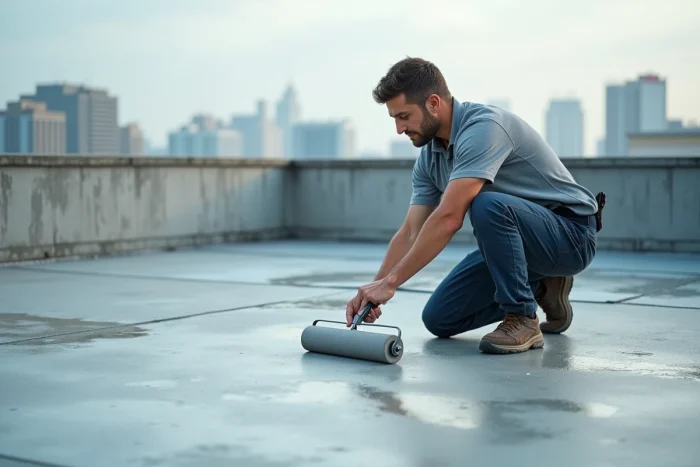
The waterproofing of a terrace is not just about choosing a waterproofing product. The type of substrate, local climate, and quality of implementation determine the actual lifespan of the protection. Comparing waterproofing systems based on measurable criteria (durability, compatibility with the substrate, behavior under thermal cycles) allows us to distinguish solutions that last over time from those that crack after a few seasons.
Thermal cycles and micro-cracks: the factor that comparisons overlook
Feedback from design offices since 2022-2024 indicates a notable increase in infiltration claims on terraces. Two phenomena are combining: intense rainfall episodes, which saturate water drainage, and the repeated expansion and contraction of slabs and screeds during heat waves.
These thermal movements generate micro-cracks that short-circuit waterproofing systems poorly decoupled from the substrate. A rigid coating applied directly on a screed without a decoupling layer or without an appropriate primer will endure these mechanical stresses without being able to absorb them.
The elongation capacity of the waterproofing product then becomes the discriminating criterion. A polyurethane resin or an elastic membrane can withstand these cycles without breaking, whereas a conventional surface water repellent only protects against capillary absorption, not against active cracking. Before choosing a system, it is essential to identify whether the terrace is working (terrace on pedestals, slab on grade, roof terrace) or if it is structurally stable.
In addition to this analysis, the advice from SOS Urgence Dépannage details several techniques suitable for each terrace configuration.
Comparison of terrace waterproofing systems by substrate
Not all waterproofing products are suitable for all substrates. The table below contrasts the main families of solutions based on the terrace material.
| Waterproofing System | Compatible Substrates | Elasticity | Estimated Lifespan | Main Limitation |
|---|---|---|---|---|
| Polyurethane Resin | Concrete, tiles, wood (with primer) | High | Long | UV sensitive without finish |
| Bituminous Membrane | Concrete, roof terrace | Medium | Long | Technical installation (welding or bonding) |
| Liquid Waterproofing System (SEL) | Concrete, screed, old tiles | High | Medium to long | Requires multiple layers |
| Surface Water Repellent | Stone, concrete, wood | None | Short to medium | Does not fill existing cracks |
| Synthetic Membrane (PVC, EPDM) | Roof terrace, terrace on pedestals | High | Long | Requires mechanical protection |
Polyurethane resin and liquid waterproofing systems dominate for tiled or concrete terraces subjected to thermal movements. In contrast, bituminous and synthetic membranes remain the reference for roof terraces, where they can incorporate fire reaction criteria (Broof(t3) classification) required on accessible terraces of buildings or ERP.
Wood terrace waterproofing: specific constraints and common mistakes
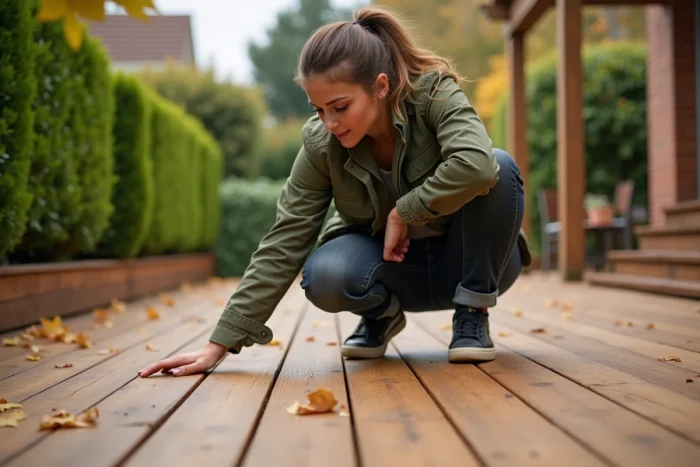
Wood moves. It swells with moisture and shrinks during dry periods. Applying a rigid waterproofing product on a wooden deck is like putting a bandage that will crack at the first seasonal cycle.
On a wooden terrace, protection involves a two-step system. First, a penetrating water-repellent treatment that limits water absorption into the wood mass. Then, managing water underneath: ventilation under the decking and the slope for drainage are more critical than the surface product.
The most common mistakes on wooden terraces include:
- Applying a thick film-forming resin that traps moisture under the layer and accelerates wood rotting
- Neglecting the minimum drainage slope, leading to water stagnation between the boards and permanently saturating the wood
- Omitting the appropriate bonding primer for wood, resulting in the waterproofing product detaching after a few months
For wooden terraces supporting combustible decking, the requirements for fire reaction on accessible roof terraces sometimes impose heavy protection or a specific waterproofing system under the decking, a point rarely addressed in guides for homeowners.
Bonding primer and substrate preparation: the phase that determines everything
A high-performance waterproofing product applied to a poorly prepared substrate will not hold. Preparation often takes more time than the application itself, and that’s normal.
The bonding primer creates the chemical link between the substrate and the waterproofing system. Without it, the resin or liquid membrane adheres only mechanically, which is rarely sufficient against the stresses of an outdoor terrace.
Substrate preparation follows a precise logic:
- Clean the surface to remove moss, grease, and residues (high-pressure cleaner or brushing depending on the material)
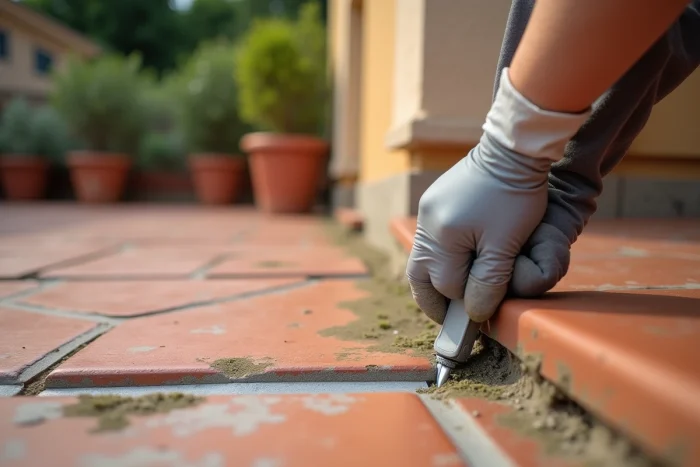
- Repair active cracks with a compatible flexible sealant before any application of the primer
- Apply the bonding primer while respecting the indicated drying time, which varies according to ambient temperature and substrate humidity
- Check that the substrate’s moisture content is within the acceptable range for the chosen product (a substrate that is too wet prevents adhesion of most resins)
On old tiles, the primer must be formulated for closed and non-porous surfaces. On raw concrete, a porosity-regulating primer prevents the substrate from absorbing the resin unevenly and creating weak zones.
Maintenance and actual durability of terrace waterproofing
The waterproofing of a terrace degrades due to lack of maintenance, not due to product failure. Water drains blocked by leaves or debris cause stagnation that puts pressure on joints and upstands.
A visual inspection at least twice a year (after winter and after summer) allows for spotting detachments, blisters, or emerging cracks before they become infiltrations. The waterproofing details at the perimeter and around the drains are the most vulnerable areas: this is where claims typically start.
On roof terraces, the sizing of rainwater drains deserves regular verification, as more frequent intense rainfall episodes can saturate systems designed for flows previously considered sufficient.
The initial choice of the waterproofing system matters, but the regularity of maintenance determines the actual lifespan of the protection. A high-end membrane neglected for five years will protect less effectively than a standard system inspected each season.