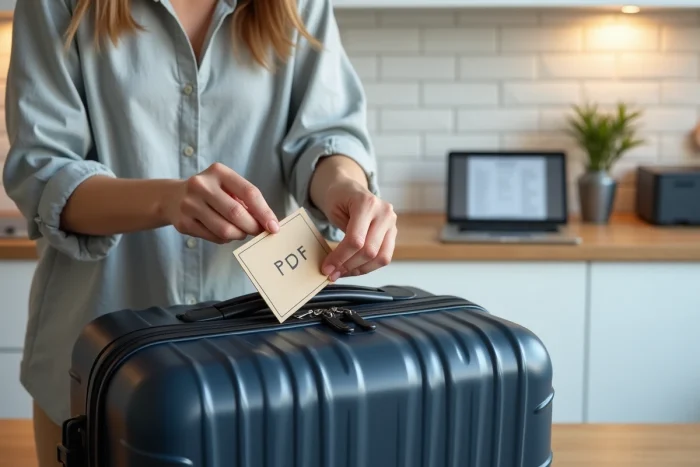
Printing a label for your suitcase takes less than two minutes. Download a free PDF, fill in the fields, cut it out, attach it. The action seems trivial, but the content of this label raises a question that most of the models available online ignore: what information should actually be included, and what is better left out?
Train, plane, or bus baggage label: the useful fields are not the same
On a long-haul flight, checked baggage passes through several hands, sometimes transiting through an intermediate airport, and can be separated from its owner for hours. The label must allow the airline to quickly locate the passenger. A name, a reachable phone number at the destination, and an email address are sufficient in most cases.
By train, the situation is different. SNCF offers a baggage labeling service, but suitcases remain under the direct supervision of the traveler, in the compartment or at the end of the carriage. The label is mainly useful in case of forgetting on board. Here, a name and a phone number cover the need, without the necessity of adding a postal address.
For bus journeys (long-distance lines like FlixBus or BlaBlaCar Bus), luggage is placed in the hold without systematic labeling by the carrier. Downloading a printable baggage label in PDF then becomes a useful reflex, as no automated tracking system takes over in case of loss.
- Plane: first name, last name, phone number, email address. The full postal address is not required by most airlines.
- Train: name and phone number. The SNCF lost property service operates with these two pieces of information.
- Long-distance bus: name, phone number, and possibly the reservation number, to speed up baggage identification at the depot.
Personal data protection on a suitcase label
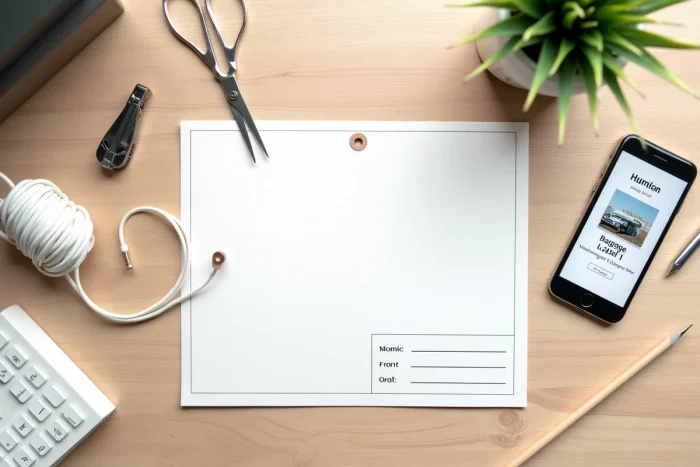
The free PDF templates found online almost all offer the same fields: name, first name, full postal address, phone, email. Filling out all of them amounts to displaying on a piece of cardboard, visible to all, sufficient information to locate an empty home during your vacation.
The risk is not theoretical. A suitcase on an airport conveyor belt exposes its label to dozens of eyes. On a train platform, it’s the same. Reducing the fields to the bare minimum limits this exposure without harming baggage identification.
What can be removed without losing effectiveness
The full postal address is the most sensitive and least useful field. In case of loss, no one will return your suitcase by mail without contacting you first. A phone number and an email address replace the postal address in almost all scenarios of recovery.
Some travelers add the address of their hotel or place of stay rather than their home address. This approach offers a compromise: it facilitates the return of the baggage to the destination without revealing the primary residence.
Free PDF template: paper weight and attachment to baggage
Downloading a PDF file and printing it on ordinary paper produces a label that will not withstand a flight with a layover. A paper with a sufficiently dense weight (like cardstock) holds up better to handling in the hold, humidity, and friction against other luggage.
Laminating adds a crucial layer of protection. An adhesive laminating film, available at stationery stores, wraps the label and makes it water-resistant. Without a laminator, wide adhesive tape applied on both sides serves as a makeshift solution.
Attachment method according to the type of baggage
A hole punched in the corner of the label, threaded with a tie or a plastic zip tie, constitutes the most reliable attachment. Rubber bands break, strings come undone. The zip tie withstands shocks and does not detach in the hold.
For a backpack, attaching the label inside the top flap or in an outer zip pocket protects the data while remaining accessible. On a hard suitcase, the telescopic handle offers the most stable attachment point.
Printable baggage label: designing a readable and simple template
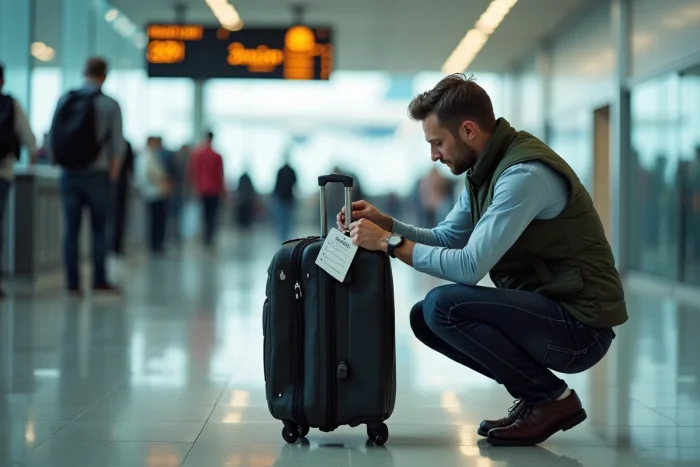
The most effective templates are also the simplest. A light background, a sans-serif font large enough to be read from a distance, and a strong contrast between the text and the background. Decorative labels with busy patterns or pastel colors hinder readability.
- Font: sans-serif (like Arial or Helvetica), body large enough to remain readable after lamination.
- Fields: name, phone, email. Leave the postal address blank or replace it with the destination address.
- Format: horizontal rectangle, compatible with the width of a standard suitcase handle.
- Filling: with a permanent ink pen rather than a standard ballpoint pen, which smudges when in contact with moisture.
Some templates include a QR code linking to an online contact sheet. The idea is appealing, but it assumes that the person who finds the luggage has a smartphone and takes the time to scan the code. The QR code complements the classic label without replacing it.
The question of compatible formats across different modes of transport remains poorly documented. Airlines accept personal labels in addition to their own barcode labeling. SNCF does not impose a mandatory format for voluntary labels. Field reports vary on this point for bus carriers, where no common standard applies.
Preparing a printable baggage label in PDF takes a few minutes. Choosing the information to include deserves a bit more thought, especially when the suitcase will pass from hand to hand far from home.