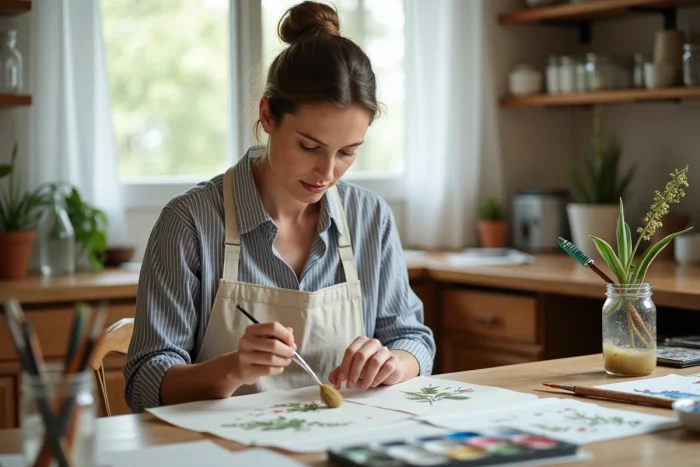
Finding a creative activity that captivates both a six-year-old child and a beginner adult is a challenge rarely addressed by craft hobby websites. Most online tutorials offer projects categorized by age, without ever questioning the possibility of simultaneous engagement. What criteria allow for the selection of a creative hobby at home that meets the expectations of the whole family?
Compatibility Criteria Between Children and Adults for Creative Hobbies
The main pitfall of a shared creative session lies in the disparity of motor skills and patience. A preschool child loses concentration after about twenty minutes on a repetitive task. A beginner adult, on the other hand, disengages when the result seems too childish.
For an activity to work in pairs, three parameters come into play: the duration of the task, the level of precision required, and the possibility of personalizing the final result. A modular project, where each participant contributes to their part with their own level of detail, resolves most frustrations.
| Criterion | Suitable Activity (example) | Risk if Ignored |
|---|---|---|
| Short duration (less than 30 min) | Rock painting, collage | The child abandons midway |
| Simple action but varied result | Stamping, stencils | The adult gets bored quickly |
| Free personalization | Textile customization, notebooks | The project seems imposed, motivation drops |
| Shareable and safe materials | Paper, glue, markers, yarn | Usage conflict or safety risk |
This table summarizes the four criteria for choosing an intergenerational creative activity. Each row points to a common cause of failure that idea catalogs do not mention.
Various supplies for this type of projects are listed on the Comptoir d’Encre website, which includes stamps, inks, and creative stationery accessories usable from a young age.
Painting and Collage at Home: Two Formats That Engage All Levels
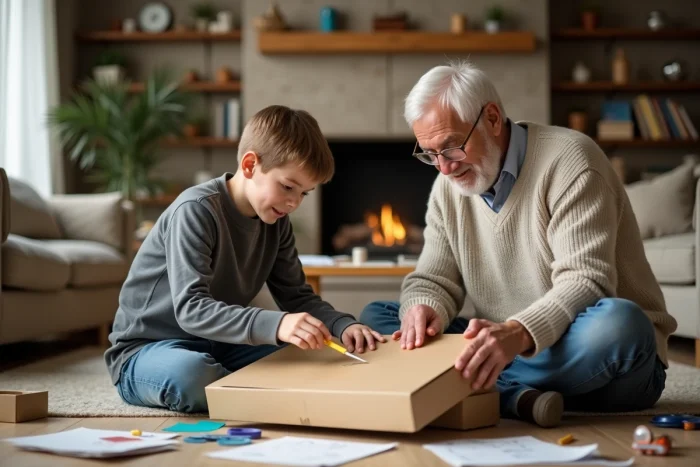
Painting remains the most practiced creative hobby in families, but its effectiveness depends on the chosen medium. Painting on a plain A4 sheet rarely produces a satisfactory result for an adult. Painting on a three-dimensional object (stone, clay pot, cardboard box) changes the game.
Painting on Volume Rather Than Flat Paper
A stone or a small pot offers a limited surface that suits a child’s concentration. The adult can work on a finer pattern on the same type of support, without the two projects competing visually. The three-dimensional support equalizes levels without simplifying the project.
Collage works on the same principle. Cutting shapes from colored paper, fabric scraps, or magazine pages, and then assembling them on a sturdy cardboard, produces a graphic result regardless of the participant’s age. The child glues freely, while the adult composes a more structured arrangement.
The Role of Shared Materials
Using the same supplies around the table creates a group dynamic. Markers, PVA glue, rounded scissors, and ink stamps are manipulable by a child as young as five or six while offering enough possibilities for an adult. Common materials eliminate hierarchy among participants.
Trendy Creative Activities Suitable for Families: Simplified Macramé and DIY Notebooks
Short and visual tutorials shared on social media have brought practices like macramé back into the spotlight. Once limited to complex wall decorations, knotting now comes in accessible versions: bracelets, keychains, small hangings.
A child can make a three-strand bracelet while an adult works on a more elaborate flat knot. Macramé works in pairs because the basic action remains the same, only the complexity of the pattern varies.
Homemade Creative Notebooks and Journals
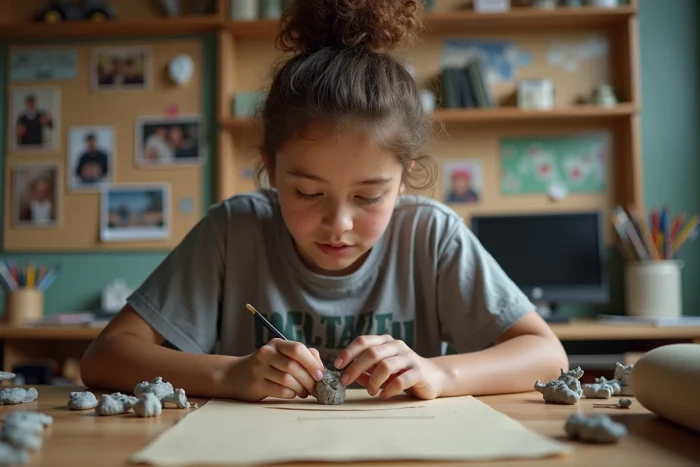
Making a notebook from folded, stapled, or sewn sheets, and then decorating it, constitutes a complete two-part project. The construction phase (folding, assembling, binding) engages motor skills. The decoration phase (stamping, coloring, collaging) allows each person’s creativity to flow.
This format has an additional advantage: the notebook becomes a usable object after the session. The child uses it for drawing, while the adult uses it for notes or sketches. A creative project that produces a functional object maintains the motivation of both participants.
Organizing an Intergenerational Creative Session Without Friction
The success of a shared activity relies as much on preparation as on the choice of the project. A few concrete principles reduce dropouts along the way:
- Prepare all the materials before starting, spread out on the table and accessible to everyone, to avoid interruptions that break the child’s concentration.
- Offer two levels of instructions for the same project: a free version (the child chooses colors and shapes) and a guided version (the adult follows a model or template).
- Limit the session to a duration announced from the start, ideally less than 45 minutes, so that no one gets stuck on a project that drags on.
- Plan a visible drying or storage space, where the creations remain displayed for a few days, which values each person’s work.
These principles apply to painting, collage, macramé, or notebook making. The key lies in logistical anticipation rather than project complexity.
Creative hobbies at home gain interest when they stop being segmented by age group. A beginner adult and a six-year-old child share more commonalities than one might think: both are discovering a skill, seeking a visible result quickly, and enjoying the freedom to personalize. Choosing an activity based on these convergences, rather than a list of projects categorized by difficulty, changes the dynamic of a family creative session.