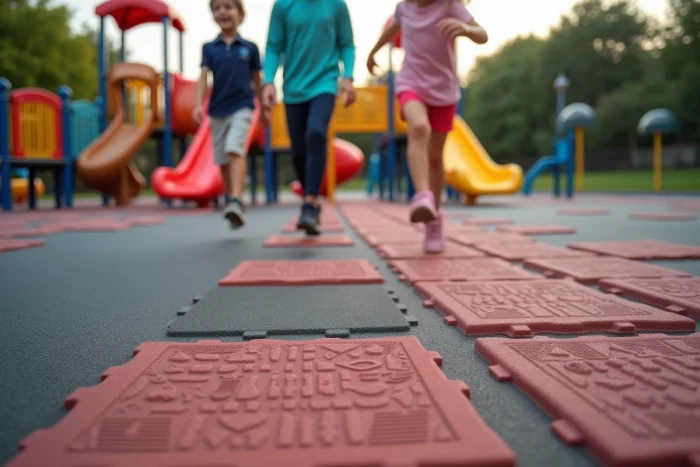
Local authorities and public space managers who set up a playground face a choice of flooring that impacts children’s safety for several years. Rubber, in the form of tiles or poured surfaces, dominates the market for shock-absorbing playground surfaces. Behind this dominance lie more nuanced technical questions than mere comfort underfoot: actual regulatory compliance, material aging, and the environmental impact of recycled aggregates.
Critical fall height and actual thickness of the shock-absorbing surface
Most articles on rubber surfaces for playgrounds mention shock absorption as the main advantage. The topic deserves to be explored beyond this general statement.
The European standard EN 1177 defines the testing method for assessing the impact attenuation of a surface. It measures the critical fall height (HIC), which is the maximum height from which a fall onto the surface does not cause a fatal head injury. This height directly depends on the thickness and density of the installed surface.
One point that product sheets do not always specify: the required thickness varies according to the installed equipment. A slide with an accessible highest point exceeding two meters does not require the same tile as a low motor skills structure. Choosing a rubber surface for play areas without considering the actual fall height of each piece of equipment amounts to installing a safety device that is partially unsuitable.
Compliance is not only verified at delivery. Material aging, UV exposure, freezing, and repeated foot traffic from children alter the shock-absorbing properties over the years. Field reports vary on this point: some managers observe notable degradation after a few years, while others report satisfactory performance over longer periods, depending on the quality of the initial installation and maintenance.
EPDM tiles, recycled SBR, or poured rubber: how the material changes
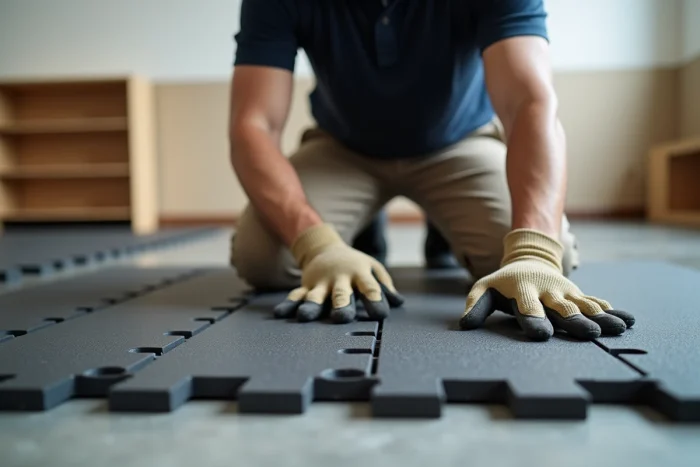
Talking about “rubber flooring” as a single product is misleading. Three main families share the market, each with distinct characteristics.
- Recycled SBR rubber tiles are made from ground used tires. They offer a good cost-to-shock-absorption ratio but raise concerns about the leaching of chemicals, especially in hot weather.
- EPDM aggregates (ethylene-propylene-diene monomer) make up the top layer of the most efficient tiles or poured surfaces. This material is more resistant to UV and allows for a wide range of colors, but its cost is significantly higher than that of SBR.
- Poured rubber on-site creates a seamless surface that can adapt to all terrain shapes. Installation requires skilled labor and favorable weather conditions during application, making the result more dependent on the quality of the installer.
The choice between these options is not just a matter of budget. The density of the aggregate, the polyurethane binder used, and the thickness of the shock-absorbing layer underneath together determine the actual performance of the surface against the impact of a fall.
European regulations on microplastics and rubber playground surfaces
Since the adoption of the regulation (EU) 2023/2055 amending Annex XVII of REACH, rubber infill granules used on sports surfaces and playgrounds are subject to progressive restrictions. This text specifically targets the dispersion of microplastics in the environment.
For playground managers, this regulatory evolution has concrete consequences. Loose aggregate surfaces (like rubber mulch) are the first to be affected, as particles easily disperse outside the installation area. Tiles and poured surfaces, where aggregates are bound by a polymer, present a lower risk of dispersion but are not exempt from concerns about long-term wear.
The available data do not yet allow for precise quantification of micro-particle leaching from recycled rubber tiles under real outdoor playground usage conditions. Ongoing standardization efforts aim to establish reliable measurement protocols to assess this phenomenon over the lifespan of the surface.
Maintenance and actual lifespan of a rubber surface for playgrounds
The durability claimed by manufacturers depends on parameters that are rarely detailed in commercial arguments.
A properly installed poured rubber surface on a draining substrate performs better than a tile laid on poorly prepared ground where water stagnates. The quality of drainage beneath the surface conditions its longevity as much as the material itself. Foams, freeze-thaw cycles, and moisture stagnation accelerate delamination and cracking.
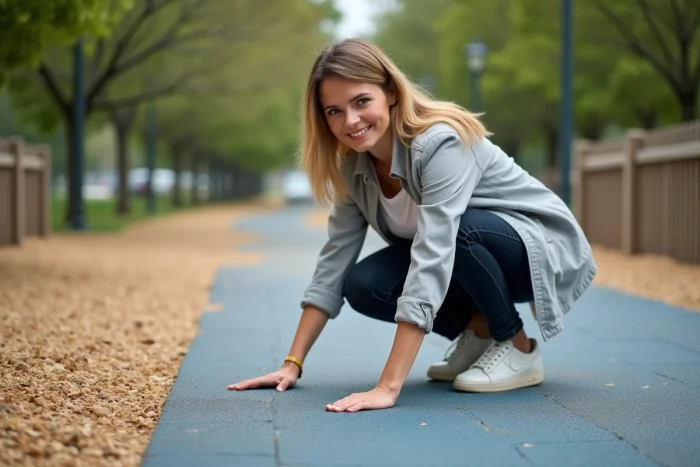
Routine maintenance remains limited: regular cleaning to prevent the accumulation of organic debris, checking the joints between tiles, and occasional replacement of damaged elements. In contrast, a locally damaged poured surface requires specialized intervention, whereas a defective tile can be replaced individually.
Warning signs to monitor on an existing surface
- Visible delamination of tile edges or bubbles on a poured surface
- Aggregates that detach upon touch, indicating advanced wear of the binder
- Areas where the surface has hardened and lost its flexibility, reducing shock-absorbing capacity
- Presence of persistent moss or mold despite cleaning, indicating a drainage problem
When these signals appear, an impact test according to standard EN 1177 allows verification of whether the surface still fulfills its safety function. Waiting for a serious fall to react exposes the manager to direct liability.
The choice of a surface for playgrounds is not limited to comparing technical sheets. Compliance with regulations at installation, ongoing monitoring, and anticipating regulatory constraints on microplastics are the three axes that separate a truly secure setup from a mere layer of rubber laid on the ground.